ChatGPT does not automatically plagiarize, but its responses can resemble existing work, repeat uncited ideas, or contain unreliable references. Whether its output counts as plagiarism depends on the content, how you use it, and the rules that apply to your work.
ChatGPT can help you brainstorm ideas, explain difficult topics, and organize information. However, its responses are not guaranteed to be original or accurate. Before using AI-generated text in an assignment, article, or report, verify its claims, check its sources, and follow the relevant citation rules.
What Is Plagiarism?
Plagiarism occurs when someone uses another person’s words, ideas, or work without giving proper credit. It can involve copied sentences, rewritten ideas, or material presented in a way that misrepresents its original source.
Common types of plagiarism include:
- Direct plagiarism: Copying text from a source without quotation marks or proper attribution.
- Paraphrasing plagiarism: Rewriting someone else’s ideas without crediting the original source.
- Accidental plagiarism: Forgetting citations or incorrectly referencing borrowed material.
- Self-plagiarism: Reusing previously submitted work without permission when the rules prohibit it.
- AI-related misconduct: Submitting AI-generated work in violation of authorship, disclosure, or academic integrity requirements.
AI-related misconduct is not always the same as traditional plagiarism. For example, submitting AI-generated writing without permission may count as academic misconduct even when the text does not match an existing source.
Plagiarism involves using someone else’s work without proper credit. Academic integrity also covers who wrote the work, which tools are allowed, and whether students honestly disclose their use of AI.
How Does ChatGPT Generate Content?

ChatGPT generates responses by predicting likely sequences of words based on patterns learned during training and the context of a conversation. It does not simply copy and paste a passage every time someone asks a question.
For example, a student might ask ChatGPT to explain photosynthesis. The model can use patterns learned during training to explain the basic concepts of photosynthesis.
However, this process does not guarantee that every response will be unique. Generated text may resemble existing material, particularly when discussing common definitions, established facts, or narrowly focused topics. ChatGPT may also present information without citations or suggest references that do not support its claims.
The key point: Newly generated wording is not proof of originality. Users still need to check for similarities, verify sources, and provide appropriate attribution.
Does ChatGPT Plagiarize? What the Evidence Shows
ChatGPT can generate text that resembles existing work, but research findings vary depending on the AI model, the type of content, and the method used to check originality.
A 2025 study published in the Proceedings of the Association for Computational Linguistics examined 50 AI-generated research documents. Thirteen experts identified 24% of the documents as significantly borrowed from existing work or paraphrased from earlier research. Another 32% showed partial overlap with previous ideas. The researchers also found that automated plagiarism detectors could miss similarities in AI-generated research.
A separate 2025 study published in Acta Neurochirurgica compared scientific abstracts and introductions generated by GPT-3.5, GPT-4, and GPT-4o. A plagiarism checker assigned the AI-generated texts high originality scores, with average scores of 98.95% for GPT-3.5, 99.35% for GPT-4, and 99.29% for GPT-4o. However, the study focused on neurosurgery papers and used a specific plagiarism checker, so these results do not establish that all ChatGPT content is original.
These studies show why AI-generated content needs careful review. Similarity results can vary depending on the content and the detection method, and a high originality score does not guarantee that every idea is original or properly attributed.
Is ChatGPT Plagiarism or Academic Misconduct?
Using ChatGPT is not automatically plagiarism. The outcome depends on how the content is used, whether sources receive proper credit, and what the relevant rules permit.
For example, consider these three situations:
- Using AI to learn: A student asks ChatGPT to explain a difficult concept before studying the original textbook. This is generally a learning activity, subject to the applicable rules.
- Using AI to reproduce existing material: ChatGPT produces wording that closely follows a published article, and the user submits it without appropriate attribution. This may raise plagiarism concerns.
- Submitting AI-generated work without permission: A student submits an AI-written essay for an assignment that requires independent writing. This may violate academic integrity rules even if a plagiarism checker finds no matching text.
The University of South Florida Libraries explains that unauthorized AI use in coursework may constitute cheating, whether or not it meets the traditional definition of plagiarism.
Rules also differ between institutions, instructors, publishers, and workplaces. Some permit AI-assisted brainstorming but restrict AI-generated writing. Others allow broader use when the writer discloses the assistance. Students who want to use AI responsibly can also learn how to use AI to study without cheating while respecting academic integrity rules.
Before submitting AI-assisted work, check the specific assignment or publication guidelines. If the rules are unclear, ask the instructor or editor what forms of AI assistance are allowed.
How to Avoid Plagiarism When Using ChatGPT
You can use ChatGPT to support research and writing while protecting the originality and accuracy of your work. These practices help reduce the risk of accidental plagiarism and unsupported claims. For more guidance on citation methods, paraphrasing, and originality checks, explore our guide on how to avoid plagiarism in an essay.
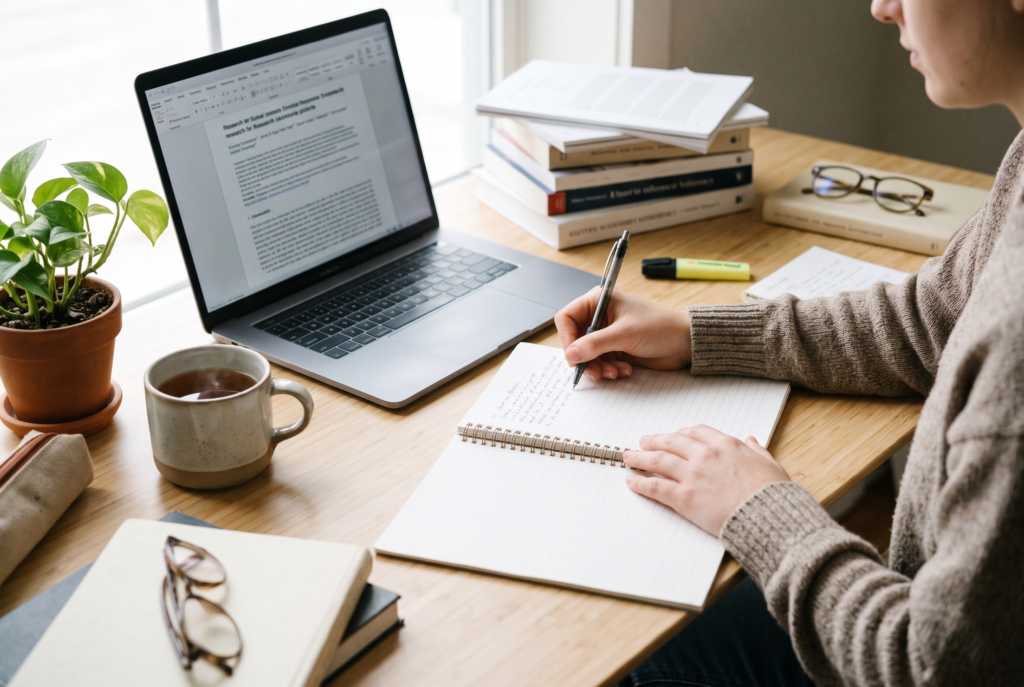
1. Use ChatGPT as a Starting Point
Ask ChatGPT to explain a topic, suggest ideas, or organize your research. Treat its response as a starting point rather than a finished piece of work.
Develop the final content with your own reasoning, examples, and analysis. This approach helps ensure that the submitted work reflects your understanding instead of simply repeating an AI-generated answer. For research-based work, an AI Research Assistant can help you gather and organize reliable sources as a starting point.
2. Verify Sources and Important Claims
ChatGPT can provide inaccurate information, outdated details, or references that do not exist. Open each cited source and confirm that it supports the relevant claim.
For research-based writing, prioritize reliable primary sources, official reports, and relevant academic publications. Never include a reference simply because ChatGPT supplied it. To catch references that don’t exist, verify citations with a citation checker before you include them.
3. Cite Original Sources Correctly
If your work uses information, quotations, or ideas from an article, book, study, or website, cite the original source according to the required style.
AI disclosure is a separate consideration. If your institution or publisher requires you to acknowledge ChatGPT, follow its instructions for describing that assistance. Citing an AI tool does not replace citing the original sources behind its factual claims. Citation requirements vary by academic style. For detailed formatting guidance, read our guide on how to cite ChatGPT in APA, MLA, and Chicago style.
4. Review and Personalize the Draft
Read the complete response and check whether it accurately represents your ideas. Remove unsupported claims, correct errors, and add analysis based on your own research.
Changing a few words is not enough to make borrowed ideas original. If a passage relies on another source, provide attribution even when you explain the idea in your own words.
5. Check for Text Similarities
A plagiarism checker can compare your writing with available sources and highlight passages that may need review. Examine each match to determine whether it is a quotation, a common expression, a properly cited passage, or material that needs revision.
A similarity score does not automatically prove plagiarism. Some legitimate writing contains matching phrases, while uncited ideas may not produce an obvious text match.
Can a Plagiarism Checker Detect ChatGPT Text?
Plagiarism checkers identify similarities between submitted text and existing sources, while plagiarism detection and AI detection serve different purposes. If ChatGPT produces wording that matches an indexed article or another available source, the checker may flag the passage.

However, a plagiarism checker does not identify every AI-generated sentence simply because AI produced it. A response may be AI-generated without matching a known source, while human-written text may contain legitimate similarities to existing material.
AI detectors serve a different purpose. They estimate whether text may have been generated by AI rather than checking only for matching passages. Their results can be inaccurate, so a detector score should not be treated as definitive proof of authorship or misconduct.
For a more complete review, combine similarity checking with source verification and careful editing. You can also run the text through an AI detector to estimate the likelihood of AI-generated writing, but treat the result as one signal among several rather than a final verdict.
Final Thoughts
ChatGPT can support research and writing, but its responses are not guaranteed to be original, accurate, or properly cited. Users remain responsible for checking the content, verifying sources, and following the rules that apply to their work.
Use AI to develop ideas and improve your understanding, then apply your own judgment to the final result. Give proper credit when you rely on another source, and disclose AI assistance whenever the relevant rules require it.
FAQs
Does ChatGPT plagiarize every time it generates text?
No. ChatGPT does not automatically plagiarize every time it generates a response. However, its output may resemble existing work or include ideas that need attribution, so check important content before using it.
Is ChatGPT plagiarism if I cite it?
Citing ChatGPT may meet a requirement to disclose AI assistance, but it does not automatically resolve every plagiarism concern. You may still need to cite original sources and follow your institution’s rules.
Can teachers detect ChatGPT plagiarism?
Teachers may use plagiarism checkers to identify text similarities and AI detectors to estimate whether writing was generated by AI. Neither tool is perfect, so results should be reviewed alongside assignment requirements and other evidence.
Does paraphrasing ChatGPT’s answer make it original?
No. Changing words or sentence structure does not automatically make content original. You must still credit borrowed ideas, verify the information, and contribute your own analysis.
Can ChatGPT provide fake citations?
Yes. ChatGPT can provide inaccurate, incomplete, or nonexistent references. Always open the cited source and confirm that it supports the claim before including it in your work.
How can I check whether ChatGPT’s response contains plagiarism?
Use a plagiarism checker to compare the text with available sources, then review flagged passages. Verify the original sources and citations, and remember that a similarity score alone does not prove plagiarism.