AI (Artificial Intelligence) has been around the tech world for longer before humans get in touch with it. The spark of AI-powered features can be seen in numerous advanced creation and communication sites. At many points, AI has not replaced humans. But has turned human creators into AI users. The release of the famous writing tool; ChatGPT forced the public to generate as much content as they wanted. But failed as Google did not accept the AI-generated content as it, identifying it as spam. To detect AI, GPT detectors and Text humanizers are developed bringing controversy between Human or AI for humanizing content.
To control machine-generated content, tech has reformed the ways to use GPT detectors for AI detection. CudekAI has developed a free AI content detector tool that detects the authenticity, privacy, and uniqueness of content by detecting AI within seconds. In this blog, you will learn how the CudekAI GPT detector works and the comparison of human or AI in the developing tech era.
How AI Detection Helps Students, Teachers, Writers & Marketers
Different types of users benefit from AI detection in different ways:
Students
Students can use AI content detector tools to ensure their assignments maintain originality and don’t unintentionally trigger AI flags. This protects academic integrity.
Teachers
Teachers can quickly analyze whether student submissions contain AI-generated patterns. Educational blogs like Online AI Detector Guide help educators understand how these systems work.
Writers
Writers often mix AI drafts with personal edits.
AI detection ensures the final version reflects human reasoning and creativity.
Marketers
Using the ChatGPT detector helps brands avoid publishing repetitive AI text that may hurt ranking or engagement.
This makes AI detection a crucial step in modern content workflows.
Why AI Detection Matters in Today’s Content Landscape
AI has transformed how students write assignments, how teachers prepare learning material, how marketers automate content, and how writers structure ideas. But with the rise of AI-powered writing tools comes a parallel need to verify authenticity. Search engines, academic institutions, and online platforms increasingly rely on advanced AI detection models to evaluate whether text is human-generated or machine-written.
This shift has sparked a growing interest in understanding Human or AI, leading many users to explore educational resources like:
AI writing helps with speed, but human writing still wins in creativity, emotional nuance, and reasoning. This blog helps you understand the difference — and how GPT detectors verify originality.
What is a GPT detector?
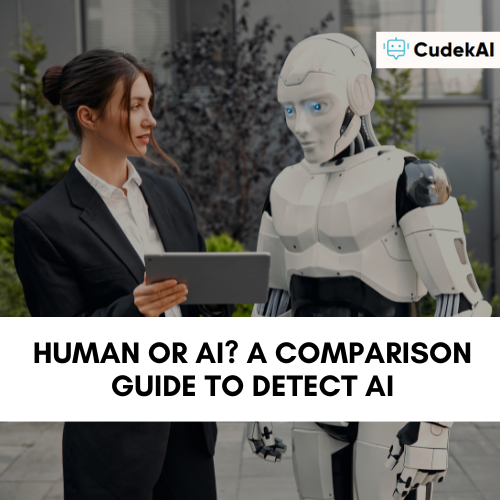
GPT detector is known as an AI detector tool. This tool is designed to detect the text whether it is generated by a human or AI. It can detect text partially and completely, to determine AI-generated and human-written text. AI detector tool detect AI and outputs the results with a detailed analysis of words. Bypass AI content detector by using an online free GPT detector, to ensure the inconsistencies and critical thinking approach.
The AI content detector tool by CudekAI is used to detect AI-generated content for SEO purposes. The tool can only be used to compare human or AI content quality. GPT detector can accurately determine the amount of AI text in the original content. Moreover, the AI detector tool highlights sentences that are not human-written. Detecting tools are the best choice to compare Human or AI in content creation. It works faster than humans for humanizing text.
How GPT Detectors Identify Machine Patterns
GPT detectors use two pillars of modern AI technology:
Pattern Probability Checks
Tools like the Free AI Content Detector analyze how predictable each sentence is. AI often writes with structured, evenly distributed complexity — something humans rarely do.
ChatGPT-Specific Tracing
When detecting ChatGPT text, platforms like Free ChatGPT Checker evaluate linguistic signatures unique to the GPT family of models.
Plagiarism + AI Overlap
Since some AI text is based on previously seen datasets, many users pair content verification with the AI plagiarism checker to detect data similarity as well as machine patterns.
These techniques improve transparency for businesses, educators, and content creators evaluating Human or AI text.
Why GPT Detectors Are Essential for Authentic Content
A GPT detector analyzes the tone, patterns, and structure of text to determine whether it was written by a human or a machine. These tools work faster than manual evaluation, and they’re widely used across industries.
For deeper understanding, resources like AI Detection Explained and Detect AI to Craft Flawless Content
outline how detectors identify shifts in coherence, structure, and predictability.
These models compare text against millions of known AI patterns to label content with high accuracy.
Technologies behind GPT detection
As a result of the huge creators’ movement to AI generative tools, copyright, plagiarism, and unauthenticity risks have been raised. GPT detection through CudekAI GPT detectors has come across to process Unique data. Here are the two advanced technologies that process the AI detector for GPT detection:
- Machine learning
AI detectors are developed with Machine learning algorithms that identify patterns in large data sets. This lets the GPT detectors compare text structure and pattern with human or AI-generated text.
- NLP (Natural Language Processing)
This technology understands the human language and tone by deep analysis of AI-generated text.
Human or AI – Comparison
AI has become a popular content-generating tool in marketing, educational institutes, organizations, and writing offices to save time and cost for human writers. Furthermore, the turn-up for the GPT detector was raised to check if the work received was written by HumaI. Here is the detailed difference in how content from Human or AI varies:
Content comparison
- AI detectors have fast processing speed and efficiency as compared to human. Human processing speed is slow and it takes hours to analyze each word written by AI. However, for informational content human are better than GPT detectors. Because these tools only detect AI and edit no authentication in content.
- Human or AI both have good learning abilities but vary in memory. Artificial Intelligence learns from the regularly updated algorithm whereas human memories are influenced by emotions and experience.
- AI lacks creativity in words because the text is generated on existing data patterns bounded by algorithms it has access to. Humans think creatively to write imaginative content. Human or AI vary a lot in this aspect that make it easy for GPT detector.
- AI writing tool and AI detector tool perform on the specific task for which tools are trained to. Humans apply knowledge flexibly with resources to be protected from GPT detection.
- The learning power of an AI detector tool depends upon the algorithms installed in it. Both have slow learning processes because AI also learns from continuous training.
What Makes Human Text Harder to Detect?
Humans naturally:
- Make small errors
- Vary sentence length
- Apply emotional context
- Break structure in unpredictable ways
This unpredictability makes human content more difficult for detectors to label as machine-written.
For more examples, read Detect AI to Protect Content Rankings — a guide on how natural reasoning patterns confuse AI classifiers.
Key Signs That Separate Human Writing from AI Writing
While AI writing tools are fast, their structure often reveals machine-like patterns.
Guides such as AI Plagiarism Detector Insights explain why AI sometimes lacks emotional depth, originality, and spontaneity.
Here’s how human writing differs:
1. Humans show emotional reasoning
Humans integrate opinions, emotion, lived experience, and nuance.
2. AI follows pattern-based logic
Models reuse learned structures from training datasets.
3. Humans vary sentence flow
AI writes in predictable rhythms, whereas humans naturally mix long, short, and medium sentences.
4. AI lacks contextual memory
Humans connect ideas using lived memory.
AI relies on token prediction.
This explains why AI detection tools are increasingly used across industries.
How AI Detection Will Evolve with New Technologies
AI detection is improving quickly and will play a major role in education, search engines, and content verification.
Future GPT detectors will feature:
- Deeper semantic comparison
- Improved tone-detection
- Multilingual detection accuracy
- Deeper dataset training
- Better detection of ChatGPT variants
These advancements are discussed in AI Detection Guide.
As models evolve, both humans and AI tools will continue shaping how authenticity is verified.
The future is AI detector Tool
Still, there are many points in AI detection where GPT detectors fail to scan AI generated content. Many tech experts analyzed the AI detector tool and believe that AI detection can’t be done without them. AI writing tools humanize AI text within seconds by rephrasing the text but the text is also detected as AI-generated. This is where Human writers can do magic.
The future of AI detectors is saved, as it is developing with regular training. CudekAI free AI text converter tool has advanced techniques for GPT detection. Detect AI with an AI detector tool to ensure high-quality writing afterward.
Author Research Insights
This article is supported by research insights from educators, content specialists, SEO analysts, and AI ethicists.
Supporting internal resources include:
- AI Plagiarism Detection Insights
- Online AI Detector Overview
- AI Detection Explained
- Tips to Detect AI
These resources show why verifying Human or AI text matters in 2025, 2026, and beyond.
Frequently Asked Questions
1. How do AI detectors identify whether text is human or AI-generated?
AI detectors analyze patterns such as sentence predictability, vocabulary distribution, and structural rhythm. Tools like the AI content detector compare these signals to known human-writing behavior.
2. How accurate are GPT detectors today?
Modern detectors are highly accurate, especially tools trained on diverse datasets. For optimal accuracy, many users combine the ChatGPT detector with a plagiarism scan using the AI plagiarism checker.
3. Can AI content be undetectable?
AI text can sometimes bypass detection when heavily rewritten. Humans introduce nuance that AI models cannot mimic perfectly. This is why natural writing still passes most AI detection tests.
4. Why do students and teachers use AI detection tools?
Students verify originality, while teachers ensure academic authenticity. Many educators rely on blogs like
Online AI Detector Guide to understand how systems evaluate writing.
5. Does AI detection affect SEO ranking?
Yes. Search engines may reduce trust signals if content appears machine-generated. Using AI detection tools helps maintain authenticity and strengthen rankings.
6. Can marketers benefit from AI detectors?
Absolutely. Marketers avoid spam-like content, improve message clarity, and maintain brand credibility by using ChatGPT detection tools.
7. Why does AI sometimes fail to detect AI text?
AI models are still evolving. Detection systems rely on probability, which can sometimes misidentify content. This is why combining detection tools and human judgment is recommended.
Wrap-up
As the popularity of AI writing tools; ChatGPT is growing rapidly, a lot of GPT detection tools claims to detect AI and differentiate between human or AI written texts. However, detectors are reliable tools to identify AI-generated texts. When it comes to Search Engine Optimization, the CudekAI advanced GPT detector tool works exceptionally to detect AI. It scans and analyzes the AI text to highlight the AI-generated text. AI content detection is becoming necessary with AI detector tool.
Try the CudekAI free AI text detector tool to verify original content.