Deepfake videos now circulate widely enough that a convincing clip can move money, swing opinion, or damage a reputation before anyone questions it. Knowing how to detect deepfakes has become a practical form of media literacy. This guide walks through the signals that expose manipulated footage, from facial movements and lighting to audio artifacts, source checks, and the detection tools that support human judgment. It also explains a point that runs through every method below. No single clue proves a video is fake, so reliable verification comes from weighing several signals together.
Why Deepfake Detection Matters
Deepfake detection matters because synthetic video has become a documented instrument of fraud, impersonation, and misinformation. A manipulated clip exploits a simple assumption, that seeing a familiar face on screen proves the person was present.
Deepfakes surface in recurring situations. Fraudsters clone an executive to authorize payments, impersonate a relative to pressure a victim, fabricate endorsements from public figures, or seed false footage into a fast-moving news cycle. Each turns on the same weakness, an unverified video treated as fact. Detection is the habit that breaks that chain.
Face and Head Movements
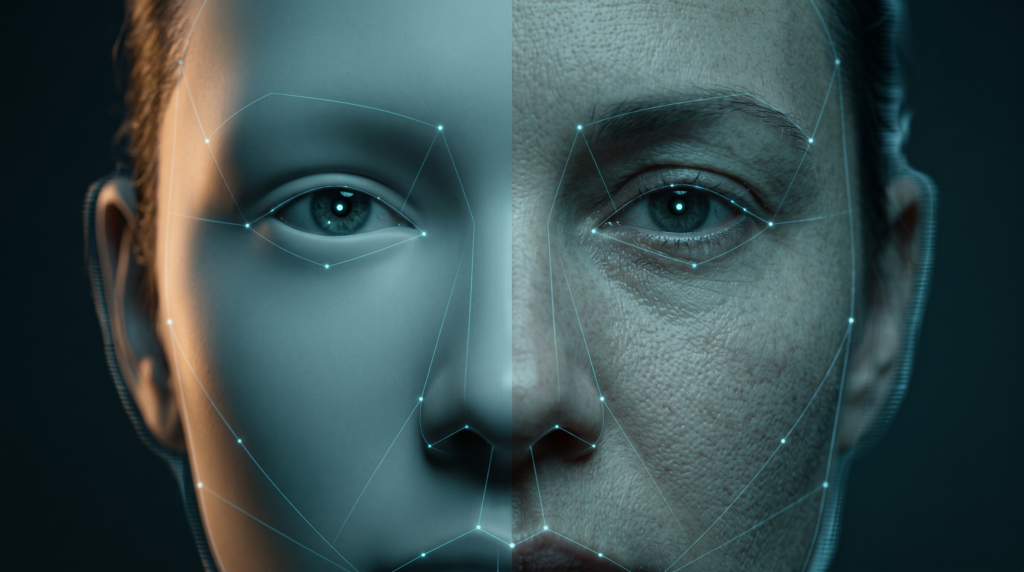
Facial behavior is the first place a manipulated video tends to break, because faces are where deepfake models do their hardest work. Reviewers should watch the eyes, mouth, and head as a connected system rather than as a frozen impression.
Several movements repay close attention. Blinking can appear too regular, too rare, or out of rhythm with speech. Eye direction may drift without a natural reason, and gaze can fail to track what the speaker seems to react to. The edges of the face, especially where the jaw, hairline, and ears meet the background, sometimes show faint blurring, warping, or a boundary that shifts as the head turns. Facial expressions can lag the emotion in the voice, and skin can look too smooth in one region and mismatched in texture against the neck or hands.
Beyond the face, body anomalies matter. Hands sometimes appear with impossible proportions, teeth may flicker between frames, and body-to-face boundaries can show misalignment. Watch whether head rotation matches body movement and whether shoulders stay in natural proportion to the head.
These signals overlap with the visual clues that expose manipulated still images, where anatomical errors and inconsistent facial features are common tells. CudekAI’s guide on how to identify AI-generated images covers those frame-level cues, and many carry directly into video, where a single suspect frame can be paused and run through an AI Image Detector. Treat each observation as a flag rather than a verdict, since natural footage of a tired person can produce some of the same irregularities.
Check Lighting, Shadows, and Image Quality
Lighting and image quality expose manipulation because synthetic rendering struggles to keep physical light consistent across a scene. A reviewer should compare the subject against the environment rather than studying the face alone.
Shadows are a reliable starting point. A shadow on the face should match the direction of shadows elsewhere in the frame, and a light source that seems to come from two places at once is a warning. Reflections deserve the same scrutiny, particularly in eyes, glasses, and shiny surfaces, where a reflection that contradicts the surroundings signals a problem. Image quality often varies within a manipulated clip. The face may carry a different resolution, sharpness, or compression pattern than the rest of the body, and the boundary between altered and unaltered regions can flicker between frames. Colors around the edges of a swapped face sometimes shift or fringe in ways the surrounding footage does not.
None of these signs is conclusive alone. Genuine videos filmed in mixed lighting, re-encoded by a social platform, or shot on low-end hardware can show uneven quality and odd reflections. The value lies in the pattern, several inconsistencies clustering around the same face rather than one isolated oddity.
Listen for Audio Artifacts and Lip-Sync Mismatch
Audio is often the weakest link in a deepfake, so careful listening catches manipulation the picture hides. A reviewer should assess the voice and the mouth together, since the two are generated or edited by different processes and rarely align perfectly.
A lip-sync mismatch is one of the clearest tells. When the lips form shapes that do not fit the sounds, or the voice drifts out of time with the mouth, the video has likely been altered. Synthetic voices carry their own artifacts. Listen for flat intonation, robotic pacing, missing breaths, abrupt cuts between words, and background noise that changes texture mid-sentence. Emotional tone that fails to match the facial expression is another signal, as is a voice that sounds subtly different from known recordings of the same person.
Plosive consonants (the hard consonants P, B, T, and D) often expose synthetic speech. These sounds require air bursts and create distinctive acoustic patterns. In synthetic voices, these bursts can sound unnaturally sharp, misaligned with mouth movement, or omitted entirely. Listen carefully for how these consonants are pronounced; natural speech should align precisely with visible mouth movement.
Audio and lip-sync checks pair well with visual review because they can disagree with each other. A convincing face over a voice that feels wrong, or clean audio over a mouth that never aligns, is the kind of contradiction that warrants deeper verification.
Read the Context Around the Video
Context often reveals a deepfake faster than any pixel-level inspection, because manipulated clips tend to arrive without the supporting evidence a real event leaves behind. A reviewer should ask what the video claims and whether the wider record agrees.
Several contextual questions help. Does any credible outlet report the same event, and does independent footage exist from another angle? Does the setting, clothing, or background match where and when the person was known to be? Is the claim surprising enough that its absence from reliable news is itself suspicious? Does the account sharing it have a track record, or was it created recently with little history? Manipulated videos often spread through channels built for virality rather than verification, and a clip that exists only on such channels deserves caution.
Context also guards against a trap that fools careful viewers. A flawless video can still be false if it depicts an event that never happened, and an imperfect video can be genuine. Checking the surrounding facts guards against both errors.
Verify the Source and Provenance

Source verification asks a more decisive question than whether a video looks real, namely where it came from and what has happened to it since. Tracing a video to its origin is often the strongest single step in confirming or dismissing it.
The most durable answer is provenance metadata. An open-standards body called the Coalition for Content Provenance and Authenticity, known as C2PA, has developed Content Credentials, a cryptographically signed record that travels with a media file and documents its origin and edit history. Its steering group includes Adobe, the BBC, Google, Intel, Microsoft, OpenAI, Sony, and Truepic. When a video carries a valid Content Credentials manifest, a reviewer can read a tamper-evident account of how it was made and whether generative tools were involved. The limitation is coverage rather than reliability. Provenance data only helps when a creator or platform attached it, and much of the video online carries none.
Reverse Search and Metadata
Where provenance data is missing, source verification falls back on tracing and reverse search. Finding the earliest known posting of a clip, identifying who published it first, and checking whether the original framing matches its current use all help establish trust. A video stripped of its origin and recirculated with a new caption is a common shape for misinformation.
Reverse image search works on video by extracting a clear frame, or several, and searching for where that image has appeared before. A match can reveal that footage promoted as breaking news is years old, lifted from an unrelated event, or already documented as a known fake. Keyframes showing faces, signs, or distinctive backgrounds return the most useful results. File metadata can add another layer when it survives. Details such as creation date, device information, and editing software may indicate whether a clip was recorded on a camera or exported by software, though this evidence is fragile. Social platforms routinely strip metadata on upload, and metadata can be edited, so its absence proves nothing and its presence should be corroborated.
Reverse search and metadata checks are strongest for footage claiming to be recent and unique. If the same frames already exist elsewhere under a different story, the claim collapses regardless of how convincing the video looks.
Deepfake Detection Tools
Detection tools extend human review by analyzing signals people cannot see, then returning a probability rather than a verdict. They belong where manual inspection has raised suspicion, not as a replacement for the checks above.
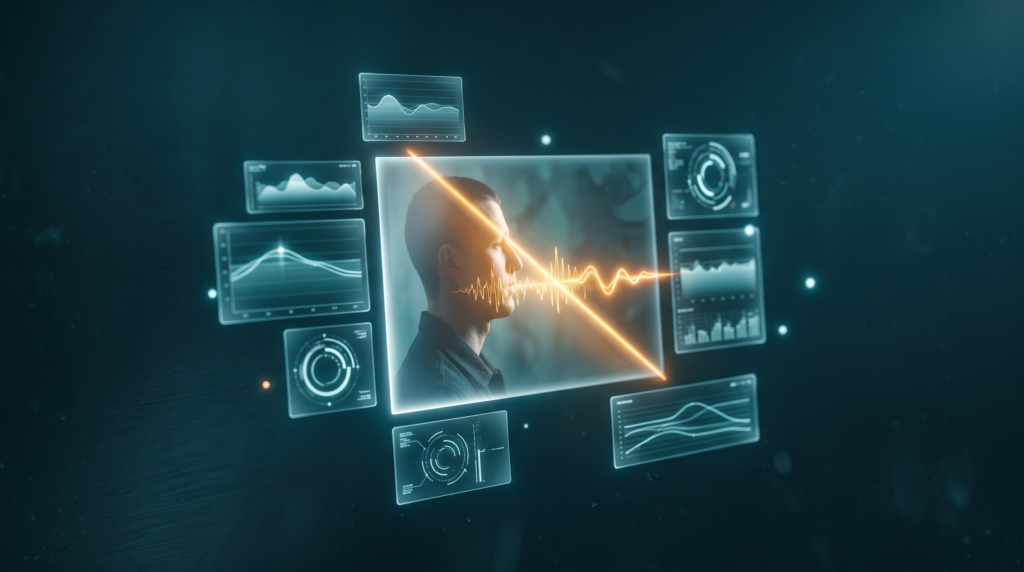
A dedicated video detector examines a clip across several dimensions at once. CudekAI’s AI Video Detector analyzes frames, motion, and metadata signals, flags deepfake indicators such as face-swap boundaries, lip-sync mismatch, facial asymmetry, and unnatural eye movement, and evaluates audio and voice signals alongside the visuals. It can read a C2PA content-credentials manifest where one is present and accepts an uploaded file or a media link from common platforms, returning an AI-probability score with plain-language reasoning. The output is a likelihood, not proof. The tool’s own documentation states that results remain probability-based because generative techniques keep evolving, and that false positives and false negatives are part of how any such tool behaves.
That caveat is why detection tools sit inside a wider process rather than ending it. The same probabilistic behavior explains why human writing and authentic media are sometimes flagged in error, a pattern examined in CudekAI’s analysis of AI detector false positives. A responsible workflow treats a tool’s score as one weighted input, strong when it agrees with other evidence, and a prompt for more scrutiny when it stands alone.
Why Deepfake Detection Is Getting Harder
Deepfake detection is becoming harder because the technology that creates synthetic video is improving faster than the tools built to catch it. The clearest evidence comes from how detectors behave against a generator they were not trained on.
A persistent generalization gap runs through the research. A UC Berkeley School of Information study found that although modern detectors can exceed 99 percent AUROC on the benchmark datasets they are tuned for, no fine-tuning method it tested achieved meaningful zero-shot generalization to deepfakes made by unseen generative models. A separate analysis published on arXiv described diffusion-based deepfakes as inherently harder to detect than the earlier GAN-based kind, because diffusion models produce output that sits statistically closer to real footage and leaves fewer generator-specific artifacts detectors learned to spot. The practical result is a moving target. Each new video model can require detectors to be retrained before they reliably recognize its output.
This is the core reason no single method should be trusted alone. As generators improve, individual clues fade, tool scores grow less certain against novel models, and provenance or contextual evidence often becomes the most dependable signal left.
The Legal Status of Deepfakes
Whether a deepfake is illegal depends on the jurisdiction, the content, the intent behind it, and whether the depicted person consented, so no single answer covers every case. The same tool that makes a satirical clip can make criminal fraud.
Recent legislation shows the pattern. In the United States, the federal TAKE IT DOWN Act, signed into law in May 2025 as Public Law 119-12, criminalizes publishing non-consensual intimate imagery, including AI-generated deepfakes, and requires covered platforms to remove such content within 48 hours of a valid request. Beyond that federal floor, legal analysts at Jones Walker note that dozens of US states have passed their own deepfake statutes covering election interference, fraud, and likeness rights. In the European Union, transparency obligations under Article 50 of the AI Act are set to apply from 2 August 2026, requiring that AI-generated content be marked in a machine-readable format and that synthetic media be disclosed. The United Kingdom, through the Data (Use and Access) Act 2025, has criminalized creating non-consensual intimate images, and jurisdictions such as China impose their own consent, watermarking, and disclosure rules.
The throughline is that context decides legality. Consent, purpose, the nature of the content, and local law all bear on whether a deepfake breaks the rules. Anyone facing a specific legal question should treat this overview as general background and seek advice qualified for their jurisdiction, since it is not legal advice.
Conclusion
Detecting a deepfake is less about finding one perfect giveaway than about building a case from several angles. Each method above contributes a piece, and their real strength shows when they agree. Because synthetic video keeps improving, any single clue can fail against the newest generators, which is why layered verification holds up where a lone check does not. A detector such as CudekAI AI Video Detector fits into that approach, adding a probability-based signal and plain-language reasoning to human judgment rather than standing in for it. Treating every unverified video with measured skepticism, and confirming before believing or sharing, is the habit that keeps manipulated footage from doing its work.
Frequently Asked Questions
Can you always tell if a video is a deepfake?
No method identifies every deepfake with certainty. Detection combines visual, audio, contextual, and source signals, and high-quality fakes can pass individual checks. Reliability comes from weighing several signals together and treating a single clue as a flag, not a conclusion.
What is the fastest way to spot a deepfake video?
Checking context and source is often fastest. Confirming whether credible outlets report the same event, whether independent footage exists, and where the clip first appeared can expose a fake before any pixel-level inspection, especially for videos making surprising claims.
Are deepfake detection tools accurate?
Detection tools return a probability, not proof, and their reliability drops against generative models they were not trained on. A UC Berkeley School of Information study found detectors that score highly on familiar benchmarks often fail to generalize to unseen generators, so tool results work best confirmed against other evidence.
Is it illegal to make or share a deepfake?
Legality depends on jurisdiction, content, intent, and consent. Non-consensual intimate deepfakes are criminalized under laws such as the US TAKE IT DOWN Act and the UK’s Data (Use and Access) Act 2025, while satire or clearly labeled content is often lawful. Specific situations warrant qualified legal advice.
What is a lip-sync mismatch and why does it matter?
A lip-sync mismatch occurs when the speaker’s mouth shapes fail to line up with the words heard, or the timing between voice and lips slips apart. It matters because voice and mouth are generated or edited separately in many deepfakes, making misalignment a common, visible tell.