Two reports, two percentages, two very different questions. A similarity score of 3% and an AI score of 78% can appear on the same document, and neither one contradicts the other.
The confusion is understandable. Both tools scan text, both return a percentage, and both sit inside the same academic integrity conversation. But plagiarism detection and AI detection look for entirely different things, produce entirely different kinds of evidence, and fail in entirely different ways. Treating one as a substitute for the other is the most common mistake in this area, and it leads students to false confidence and reviewers to unsupportable conclusions.
Here is what each system actually does, what each result can and cannot establish, and how to read them together.
The Short Answer
Plagiarism detection asks: does this text appear somewhere else? It compares a submission against a corpus of web pages, publications, and archived documents, then reports what matched and where.
AI detection asks: does this text look statistically like machine writing? It compares nothing. It measures properties of the writing itself and estimates a probability.
The first is a search problem. The second is a classification problem. That distinction explains nearly every difference that follows, including why a document can pass one check and fail the other.
How Plagiarism Detection Works
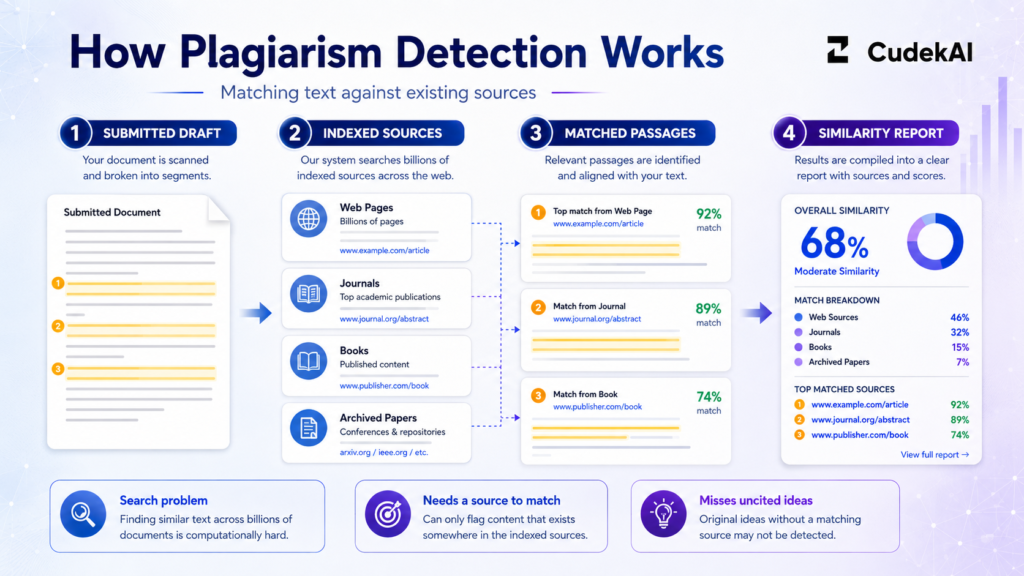
Plagiarism checkers operate on comparison. The submitted text is broken into overlapping segments, and those segments are matched against an indexed corpus: web pages, journals, books, previously submitted papers, and whatever else the provider has licensed or crawled.
Where segments align closely enough, the system records a match, the source it came from, and how much of the document those matches account for. The output is a similarity percentage plus a list of matched passages linked to their origins.
Beyond Exact Matching
Modern checkers go further than exact string matching:
- Semantic analysis catches paraphrasing, where the wording changed but the sentence structure and meaning did not.
- Patchwriting detection catches passages stitched together from several sources with light rewording.
The CudekAI Plagiarism Checker works this way, flagging duplicated and rephrased content across more than 100 languages and identifying the specific sources behind each match rather than reporting a bare score.
The Two Limits That Matter
Two properties of this approach shape everything that follows.
- It can only find text that exists somewhere it can see. A source outside the corpus, whether behind a paywall, in a printed book, or in a classmate’s unsubmitted draft, produces no match.
- It cannot flag ideas. Using someone’s argument without their words is still plagiarism under every academic policy, and no matching system will detect it.
How AI Detection Works
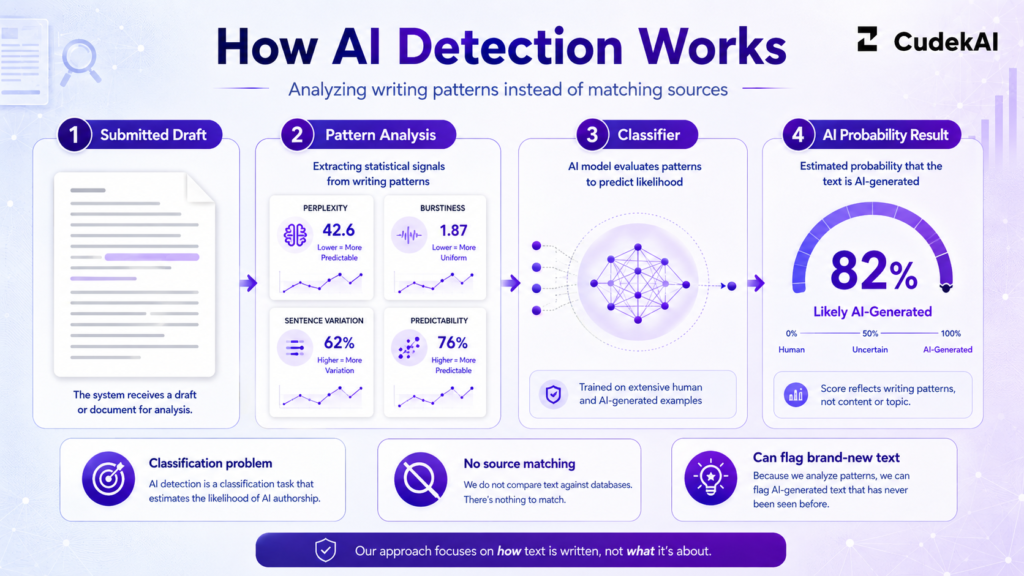
AI detection has no corpus to search. Generated text is new text, so there is nothing to match it against.
Instead, detectors measure statistical properties of the writing itself. Two come up repeatedly.
Perplexity
Perplexity measures how predictable each word choice is given what came before. Language models are built to produce probable text, so generated writing tends toward low perplexity.
Burstiness
Burstiness measures variation in sentence length and rhythm. Human writing tends to be uneven, with long sentences beside short ones. Generated text often holds a steadier pace.
A classifier trained on human and machine samples weighs these and other signals, then returns a probability that the text was machine-produced. Better tools report it at more than one level. The CudekAI AI Detector classifies across sentences, paragraphs, and full documents with confidence scoring, which matters because a document-level score and a single highlighted sentence answer different questions.
The critical property: AI detection never needs a match to raise a flag. It can flag text nobody has ever written before. It can also flag text a human wrote from scratch if that writing happens to be predictable and evenly paced.
For more on how these signals are weighed, see our guide on how AI detectors work.
The Difference That Matters Most: What Each Report Actually Proves
This is where the two systems separate, and it is the part most comparisons skip.
A plagiarism report produces examinable evidence. It names a source. Anyone can open that source and check whether the match is genuine copying, a properly quoted passage, a bibliography entry, or a common phrase that happens to appear everywhere. The claim is falsifiable, and the person accused can engage with it directly.
An AI detection report produces a probability and nothing else. There is no source to open, no passage to compare, no external record to check. When Weber-Wulff and colleagues at the European Network for Academic Integrity tested fourteen detection tools in 2023, this was their central objection. Unlike text-matching systems, where a matched source can be produced and examined, AI detection output leaves an accused writer with nothing concrete to argue against.
The practical consequence: a similarity report can support a specific, checkable allegation. An AI score, on its own, cannot. It is a reason to look more closely and to have a conversation about process, not a finding of fact.
Why a Clean Plagiarism Report Says Nothing About AI Use
The single most common error in this area is treating a low similarity score as proof that text was not AI-generated.
It is not, and the reason is structural. Generated text is original in the narrow sense that matters to a matching system: it was produced fresh and exists nowhere in any corpus. A document written entirely by a language model can legitimately return a similarity score of zero.
The reverse also fails. A document flagged as AI-written may still contain plagiarism, since a model can reproduce phrasing close to its training data, and a writer can paste copied material into an AI-assisted draft.
The Four Possible Combinations
| Similarity Score | AI Score | What It Suggests |
| Low | Low | No matched sources, no strong machine signal |
| Low | High | Possibly generated, or human writing that reads as predictable |
| High | Low | Copied or poorly cited material, human-written |
| High | High | Generated text reproducing existing sources, or a mixed draft |
The two scores are independent measurements. Neither validates nor cancels the other.
Where Each One Gets It Wrong
Both systems produce false positives, but for different reasons and at very different rates.
Plagiarism Checkers Over-Flag Predictably
Bibliography entries, correctly quoted passages, standard methodology phrasing, and common terminology all register as matches. A 30% similarity score composed mostly of references and quotations is not misconduct. This is why a similarity report is reviewed rather than read as a verdict and why source-level detail matters more than the headline percentage.
AI Detectors Over-Flag Less Predictably
That unpredictability makes their errors harder to dismiss. Published figures vary enormously depending on what is being measured:
- Turnitin reports a document-level false-positive rate below 1%, but only for documents where 20% or more of the qualifying text is flagged, and a separate rate of roughly 4% for individual highlighted sentences.
- A Stanford study published in the journal Patterns in 2023 tested seven detectors on 91 human-written TOEFL essays and found an average false-positive rate above 61%, while the same tools handled US eighth-grade essays with near-perfect accuracy. Turnitin was not among the seven tested.
Those figures are not in conflict. They measure different tools, on different texts, at different lengths, under different conditions. The pattern underneath them is consistent: AI detection is least reliable on short documents and on writing by non-native English speakers, because both produce the lower linguistic variability that detectors read as machine-like. We walk through why these false positives happen, and what the research shows, in our breakdown of AI detector false positives.That fourteen-tool evaluation found something else worth knowing. Across the fourteen tools tested, no tool exceeded 80% overall accuracy, and the dominant failure ran opposite to the one most people fear: about a fifth of unmodified AI text was misattributed to humans, rising to around half once that text had been lightly edited by hand.
Which Check Do You Actually Need?
It depends on the question being asked.
| Plagiarism Detection | AI Detection | |
| Question answered | Did this come from somewhere else, and is it cited? | Was this written by a person? |
| Method | Matches against a corpus | Measures statistical patterns |
| Output | Similarity score plus named sources | Probability score |
| Evidence produced | A source anyone can check | A likelihood, nothing external |
| Main weakness | Misses uncited ideas and unindexed sources | False positives on short and non-native text |
Use plagiarism detection when the concern is attribution. This is the routine check in academic and publishing workflows, and it produces actionable output, since every match points at a source that can be quoted, cited, or rewritten.
Use AI detection when the concern is authorship. This is a newer and narrower question, and the answer arrives as a probability rather than a fact.
Run Them in the Right Order
Most real situations call for both, because they cover different risks. A student submitting coursework needs clean citations and writing that does not read as machine-generated. An editor commissioning freelance work has the same two exposures.
The order matters more than people expect. Run the plagiarism check first. If large blocks of the document match existing sources, that is a concrete problem with a concrete fix, and it should be resolved before anything else. AI anxiety is wasted effort on a draft with citation problems. Once the similarity report is clean, run the AI check on the revised text.
How to Check Your Own Work Before Submitting
A short pre-submission routine catches most problems while they are still cheap to fix.
- Check similarity first, then read the source list rather than the score. Confirm that every match is either correctly quoted, correctly cited, or genuinely common phrasing. If you are unsure a reference is complete or formatted right, run it through our Citation Checker. CudekAI’s checker suggests APA, MLA, and Chicago references for identified sources, which turns an unattributed match into a citation rather than a rewrite. Its free tier covers up to 5,000 characters per check, enough for a section at a time. When you need to build one from scratch, our Citation Generator formats it for you.
- Rewrite what needs rewriting, then re-check. Paraphrasing that stays close to the original structure still registers, and it still counts as plagiarism under most policies. For the citation and paraphrasing methods that keep similarity low without crossing into copying, see our guide on how to avoid plagiarism in an essay.
- Run AI detection on the revised draft, and read it at the sentence level rather than as a single number. A high document score driven by one formulaic paragraph is a different problem from one spread evenly through the text.
- If a section is flagged and you wrote it, do not rewrite it to beat the score. Editing text specifically to reduce a detection percentage is difficult to distinguish from evasion, and it destroys the draft history that would otherwise support you.
Keep your drafts, notes, and version history instead. Where authorship is genuinely questioned, a record of how the work developed carries weight that no detection score can match, and it is the evidence institutional processes actually respond to.
The Distinction Worth Remembering
Plagiarism detection answers a question about sources. AI detection answers a question about patterns. One searches a corpus and shows you what it found; the other measures the text in front of it and estimates a likelihood.
That difference determines what each result can support. A similarity match points at something checkable. An AI score points at a probability, and probabilities need context, corroboration, and human judgement before they support any conclusion about a person.
Neither tool decides anything on its own, and neither was built to. They narrow where a reader should look, and the looking is still the reader’s job.
For anyone producing work that will be reviewed, the practical takeaway is to check both, in that order, and to keep the record of how the work was written. CudekAI’s Plagiarism Checker and AI Detector both run in the browser with a free tier, which is enough to see where a draft stands before it reaches anyone else.
FAQs
Can a plagiarism checker detect AI-generated text?
Generally no. Plagiarism detection matches text against existing sources, and generated text has no source to match. AI-written work commonly returns a low similarity score, which is why the two checks are not interchangeable.
Does a high similarity score mean I plagiarized?
Not by itself. Similarity scores routinely include bibliography entries, correctly quoted passages, and standard phrasing in the field. What matters is what the matched sources are and whether each one is properly attributed, which is why the source list is more informative than the percentage.
Can AI detectors be wrong about human writing?
Yes, and the rate depends heavily on the text. Short documents and writing by non-native English speakers are flagged disproportionately. Careful, correct, standard English is precisely the kind of writing these systems find hardest to distinguish from machine output.
Is using AI to write an assignment the same as plagiarism?
Institutions treat these as related but distinct. Plagiarism concerns attribution of someone else’s work; undisclosed AI use concerns authorship of your own. Many policies now address both separately, so check the specific rules that apply rather than assuming one covers the other.
Can an AI detection score alone prove I used AI?
No. A detection score estimates how closely text resembles machine-generated patterns. It establishes nothing about who produced the document, which is why it functions as a prompt for review rather than as evidence.