AI detector false positives occur when text written entirely by a person is scored as machine-generated. These incorrect classifications happen often enough that detection companies publish false-positive figures for their tools.
Those figures do not agree. Some vendors report fewer than one wrongly flagged document in a hundred. A study of seven detectors found they misclassified more than half of a set of essays by non-native English speakers. Neither is wrong. They describe different tools, measured on different writing, and under different conditions.
What follows covers why these systems misread human writing, why rates diverge, what independent research shows, and what a detection score can support.
What a false positive means in AI detection
A false positive is human-written text classified as AI-generated. Its mirror image, a false negative, is AI-generated text that passes as human. Every detector produces both, and the balance is a design decision. A missed case of AI use is unfair to everyone who worked honestly, but a false accusation lands on one identifiable person who then has to defend original work. Because the second failure is more damaging, most systems are tuned to accept the first. Turnitin says so plainly, allowing some AI writing through to hold false positives down and noting that a document it scores at 50% AI could contain as much as 65%.
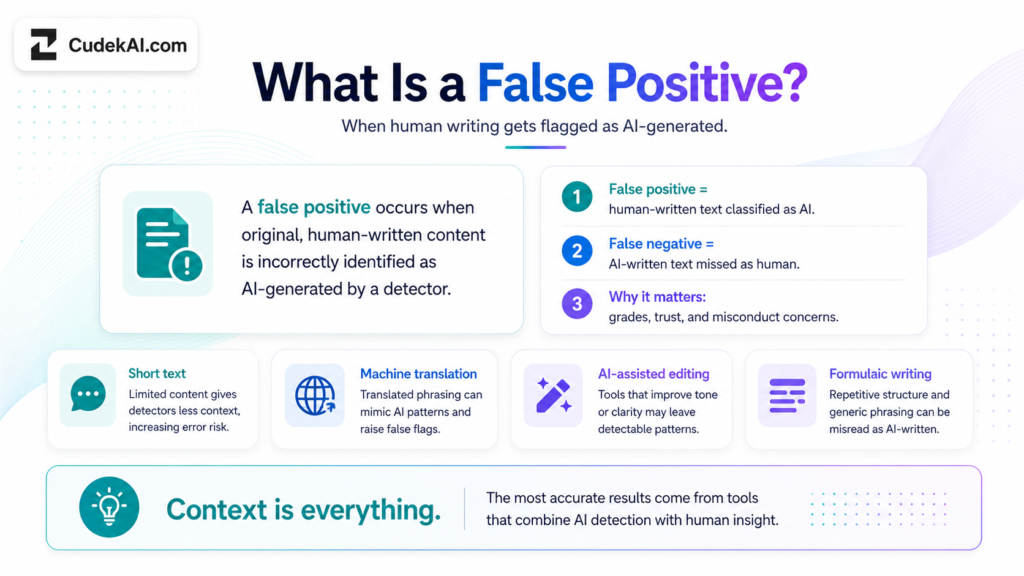
A flag can trigger a misconduct case, cost a grade, or leave a freelance writer arguing with a client.
How AI detectors decide what looks machine-written
Detection systems compare text against statistical patterns learned from human and machine writing. They see words on a page and nothing else: no drafts, no research trail, no sense of who wrote them.
Two measures do most of the work. Perplexity captures how surprising each word choice is given what came before; predictable writing scores low, and since language models produce probable text, low perplexity reads as machine-like. Burstiness captures variation in sentence length and rhythm: human writing lurches between long and short, generated text holds a steadier pace.
Plenty of human writing is predictable and evenly paced. Human and generated prose occupy overlapping statistical territory, and anything landing in that overlap is caught regardless of who produced it. A false positive is the system working as designed on a passage sitting in the wrong place.
Detectors also differ from one another, trained on different data, calibrated to different thresholds and updated on different schedules, so two tools can read the same paragraph differently. No primary source documents any detector keying on specific vocabulary, despite the belief that words such as “delve” give writers away.
What causes human writing tobe flagged
Most flagged documents share at least one of these traits.
Short length
Brief texts give any detector little to work with. Turnitin raised its minimum from 150 to 300 words in May 2023 after finding a high false-positive rate on shorter submissions. A short document offers one block of text with no surrounding context, so predictions turn close to all-or-nothing and can report a piece as entirely AI.
Machine translation
A 2023 study in the International Journal for Educational Integrity, run by the European Network for Academic Integrity, tested fourteen tools. The average false-accusation rate on human-written English was 2.4%. On the human writing machine-translated into English, it rose to 11.1%.
AI-assisted editing
A 2025 study in Findings of the Association for Computational Linguistics evaluated twelve detectors on human text refined with AI tools. They frequently flagged even lightly polished writing and struggled to tell minor from major edits. What matters is whether the help was corrective or generative: Turnitin’s documentation states that ordinary spelling, grammar, and punctuation fixes from tools such as Grammarly are generally not flagged, while output from its generative features usually is. Paraphrases such as Quillbot are widely detected, and humanizer detection arrived during 2025.
Formal or formulaic prose
Uniform rhythm, stock transitions, and a rigid introduction-body-conclusion shape strip out the variation detectors that read as human. Students taught a template essay format are taught to write in the pattern the tool looks for. These are vendor observations, not measured rates.
Proximity to genuine AI text
Where human and generated writing sit side by side, detectors struggle to find the boundary. Turnitin published the distribution of its false-positive sentences: 54% sat immediately beside genuinely AI-written text, 26% two sentences away, and 10% three away. Only 10% were nowhere near any AI writing. Sentence-level errors cluster at the seams of mixed documents rather than scattering across honest ones.
Why reported false-positive rates vary so widely
Every published rate rests on the same variables: which detector and version, what kind of text, the writer’s language background, document length, the unit counted, where the threshold sits, and who ran the test.
Thresholds are the clearest illustration. Every detector sets a cut-off above which text is called AI: raising it produces fewer false positives and lets more AI through, lowering it does the reverse. The RAID benchmark, published by Liam Dugan and colleagues in 2024, found several detectors lose most of their detection power once held below a 1% false-positive rate. False positives cannot be engineered away, only traded against missed AI.
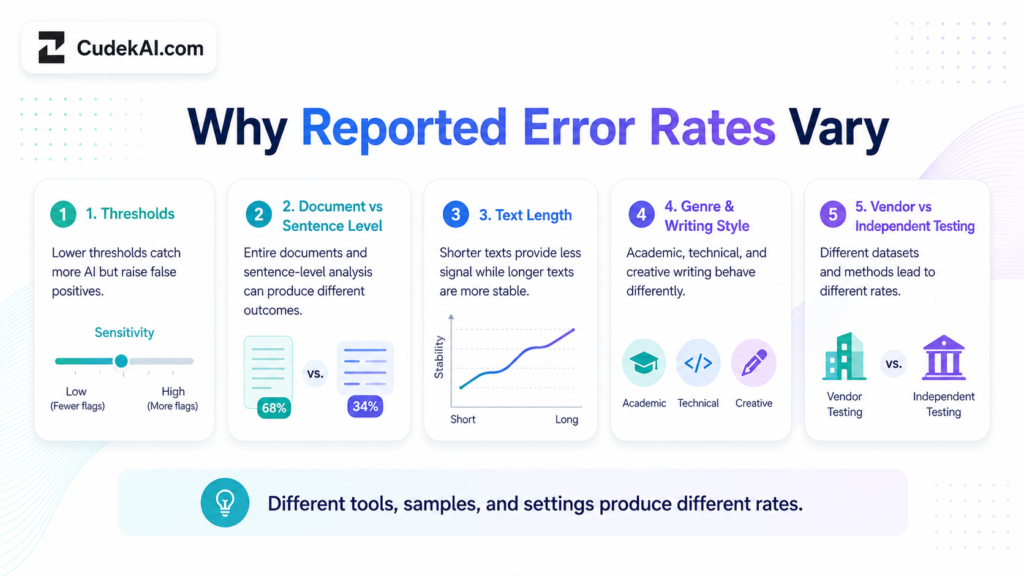
Document-level and sentence-level answers different questions
A document-level rate asks how many human-written documents are wrongly flagged overall. A sentence-level rate asks something narrower: of the sentences a tool highlights, how many are actually human? A document with one wrongly highlighted sentence is not a false-positive document, and quoting one figure as the other is the commonest error. Reports that separate the two, as the CudekAI AI Detector does with document-level and sentence-level output, at least make the distinction visible.
Text type and length limit what detection can measure
Genre matters more than headline figures suggest. A 2025 working paper by Brian Jabarian and Alex Imas at the University of Chicago’s Becker-Friedman Institute found near-zero false-positive rates for the strongest commercial detector across six everyday genres, from news and blogs to novels and résumés, though performance became case-dependent on very short passages. Systems learn from the writing they have seen, so genres that are rare online or that step outside continuous prose give them less to work with.
Single sentences, bullet lists, outlines, spreadsheet entries, and template-based text lack enough continuous prose for reliable classification, and results drawn from them carry less weight. Output from any system, the CudekAI AI Detector included, is most informative when the sample gives it sustained prose to analyse.
What independent testing shows across detectors
That evaluation covered 54 documents of known authorship, with human-written texts commissioned for the study and never posted online, so they could not have entered any training data.
No tool exceeded 80% accuracy overall, and only five exceeded 70%. On the narrower question of falsely accusing an innocent writer, results ranged from zero for several tools, Turnitin among them, to 50% for the weakest.
Detectors also fail in the opposite direction: roughly 20% of unmodified AI text was misattributed to humans, rising to around 50% once lightly edited. Across the field, more AI slips through than honest writing is caught.
What one vendor’s published figures actually count
Turnitin publishes more about its error rates than most vendors, which makes its figures the most cited and most misquoted. Students asking why Turnitin flags writing as AI usually meet one of two.
The document-level rate is below 1%, but only for documents in which 20% or more of the qualifying text is predicted to be AI-generated, a condition dropped almost every time the number is quoted. It came from a diagnostic run of 800,000 academic writing samples predating ChatGPT. Below the 20% band, false positives were more common, and since July 2024, scores between 1% and 19% appear only as an asterisk. A suppressed score is not a clean one.
The sentence-level rate is roughly 4%, meaning about four of every hundred highlighted sentences are human-written. It does not mean 4% of students are wrongly accused, though it is regularly repeated that way. The percentage covers qualifying prose only, leaving out lists, code and bibliographies.
The published figures side by side
| Figure | What it measures | Text | Measured by |
| Under 1% | Document-level, only at 20%+ AI | Pre-ChatGPT academic papers | Turnitin (vendor) |
| ~4% | Per highlighted sentence | Analysed documents | Turnitin (vendor) |
| 61.22% | Per essay, across seven detectors | 91 short TOEFL essays | Liang et al., Stanford |
| 5.19% | Same metric, comparison group | 88 US eighth-grade essays | Liang et al., Stanford |
| 2.4% / 11.1% | False accusation, 14 tools | English / machine-translated | Weber-Wulff et al. |
| 0% to 50% | Same metric, best to worst tool | Same 54 documents | Weber-Wulff et al. |
| Near zero | Best tool, medium-to-long text | Six everyday genres | Jabarian & Imas (2025) |
Vanderbilt University showed what small percentages mean at scale when it disabled Turnitin’s AI detector in August 2023: roughly 75,000 papers submitted in 2022, so a 1% rate implies around 750 wrongly labelled. A rate is also not the probability that a flagged paper is innocent, since that depends on how many submissions genuinely contain AI writing.
Figures have a shelf life: models are retrained frequently, and old reports are not regenerated, so resubmitting a document can produce a different score.
Why ESL and non-native English writing are misclassified more often
Research has raised real concerns, and the mechanism is well understood. ESL and other non-native English writers tend to show reduced variability in vocabulary and sentence construction, a long-established finding in applied linguistics. Less variability means lower perplexity, which is what these systems read as machine generation. The effect penalizes careful, correct, standard English regardless of author.
What the Stanford study found
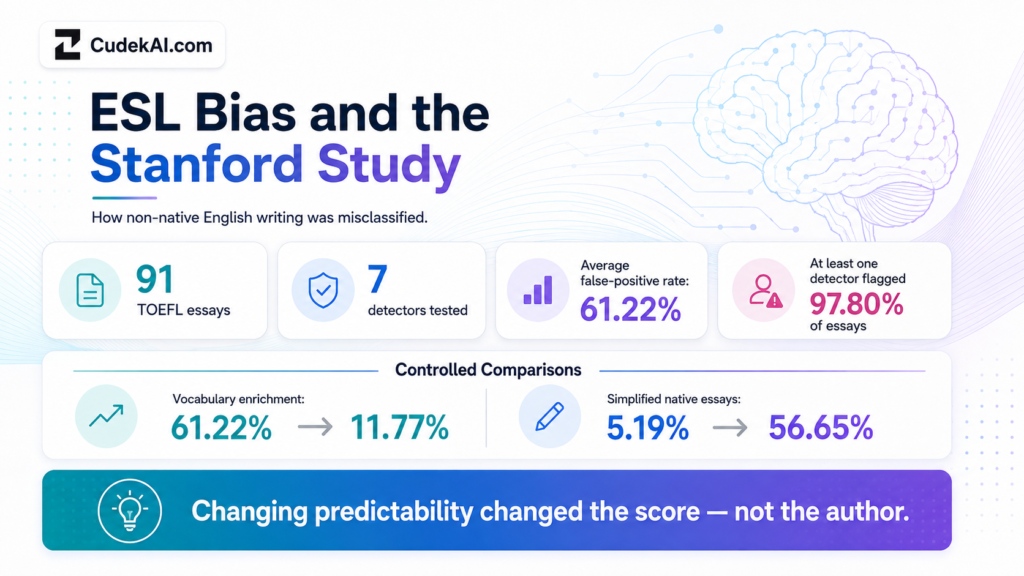
In March 2023, Stanford researchers tested seven detectors on 91 human-written TOEFL essays and 88 US eighth-grade essays, publishing in Patterns under Liang and colleagues.
The detectors handled the eighth-grade essays with near-perfect accuracy. They misclassified more than half the TOEFL essays, at an average false-positive rate of 61.22%. All seven unanimously flagged 18 of the 91, and at least one flagged 89 of 91, or 97.80%. That second figure often gets reported as a single detector flagging 97% of essays, a different and unsupported claim.
The seven tools were originality. AI, Quil.org, Sapling, the OpenAI GPT-2 output detector, Crossplag, GPTZero, and ZeroGPT. Turnitin was not among them, although the study is routinely cited as evidence about it. The authors were candid about limits: a pilot study, small samples, and most detectors built on GPT-2.
The experiment that explains the cause
The follow-up is rarely cited and is the most revealing part. The researchers used an AI model to enrich the TOEFL essays’ vocabulary toward native-speaker usage, then ran them back through the same detectors. The average false-positive rate fell from 61.22% to 11.77%. Simplifying the American eighth-graders’ word choices pushed misclassification of those essays from 5.19% to 56.65%.
Authorship never changed in either direction. Linguistic predictability did. That symmetry is the clearest demonstration that these tools measure the shape of text rather than its origin. The researchers noted an uncomfortable implication: to avoid being wrongly flagged, non-native writers may feel pressure to use AI tools on their own vocabulary.
Where vendor research reaches a different conclusion
One vendor evaluation reports a different outcome. Turnitin’s October 2023 study tested up to 2,000 texts covering first- and second-language writers at two lengths. Above the 300-word minimum, the false-positive rate was 0.014 for second-language writers against 0.013 for first-language writers, not a statistically significant difference, though both sat slightly above the 1% target.
Below 300 words, a larger gap opened between the groups, with rates significantly above target. That second finding is usually left out, and it reconciles the two bodies of research. The Stanford essays were short, and the vendor data shows the same length effect. The disagreement is about where the threshold sits, not whether length-related bias exists. Neither study covers full-length university writing by second-language authors, the case that matters most to international students.
Concerns extend beyond language. The Office of the Independent Adjudicator, the ombudsman for higher education in England and Wales, directs institutions to consider whether assumptions about AI use could be biased against students whose first language is not English, or who are disabled.
How an AI detection result should be interpreted
A score estimates how closely text resembles patterns associated with machine generation. Proof of authorship would be a finding about who produced the work, and only the second supports a disciplinary conclusion. A detector returns a probability with nothing attached, leaving an accused writer nothing concrete to argue against.
Read as an indicator rather than a verdict, the result is still useful: it flags passages worth discussing and opens a conversation about process. That is what the CudekAI AI Detector is built for: a reading of how a detection system sees a piece of writing, weighed against the effects of threshold, text type, and length. No score, from any provider, establishes who wrote a document.
Turnitin states that it does not determine misconduct and that its percentage should not be the sole basis for action. Vanderbilt holds that a report to its Undergraduate Honor Council cannot rest on a detector score alone.
One point matters most for the person accused. The Office of the Independent Adjudicator states that responsibility rests with the provider to prove the student did what they are accused of, rather than with the student to disprove it. Procedures vary elsewhere, but the principle that an accuser carries the burden is standard across misconduct processes.
Responding to a flag
None of this constitutes legal advice, and procedures differ between institutions.
Understanding the allegation comes before answering it. Students should be told in writing what they are alleged to have done, with reasonable notice of any meeting, and should receive the relevant evidence, including the detection report. Ombudsman guidance supports a viva on the content of the submission. Where the report is withheld or unclear, running the text through another system such as the CudekAI AI Detector shows how a different model reads it, though disagreement proves nothing on its own.
Three responses reliably make matters worse. Creating or backdating drafts is detectable through file metadata, and fabrication turns a defensible position into misconduct. Running the work through a humanizer is flagged by several detectors and destroys the version history that would have helped. Rewriting the submitted work after an allegation removes the original record.
Demonstrating authorship
No document proves a negative. What exists instead is converging evidence of process: traces that are hard to fabricate together and that a reviewer can weigh. Drafts and outlines, version history from Google Docs or Microsoft Word, file metadata timestamps, saved sources and reference libraries, and citations that are real and locatable.
The strongest evidence remains the ability to discuss and explain the work: a writer who can account for why an argument was structured that way carries weight no score can match. Disclosing tools genuinely used, such as a grammar checker or translator, is better than having them discovered.
An absent record is not an admission. Writing in one sitting or drafting on paper is ordinary, and the burden does not shift because the trail is thin.
What the evidence supports
False positives are a property of how detection works rather than a malfunction. Published rates disagree because they count different things: per document or per sentence, above or below a threshold, measured by a vendor or independently.
The Stanford experiment explains the mechanism most directly: changing nothing but the predictability of the wording moved the same essays in and out of being flagged. A score describes the shape of text, not its origin.
None of that makes detection worthless. Used as a screening step, it shows how a passage reads to a model before submission, and the CudekAI AI Detector is built for that purpose: a clear reading of how text is classified, treated as an indicator rather than a verdict. Alongside drafts and version history, it is one part of a fuller picture rather than a substitute.